Exposure to What?
Every partnership offer promises visibility. Here's the question I ask before anybody says yes.
I.
A client forwards me a partnership offer. Bigger brand, bigger audience, and the pitch is one I've seen a hundred times... we'll give you exposure.
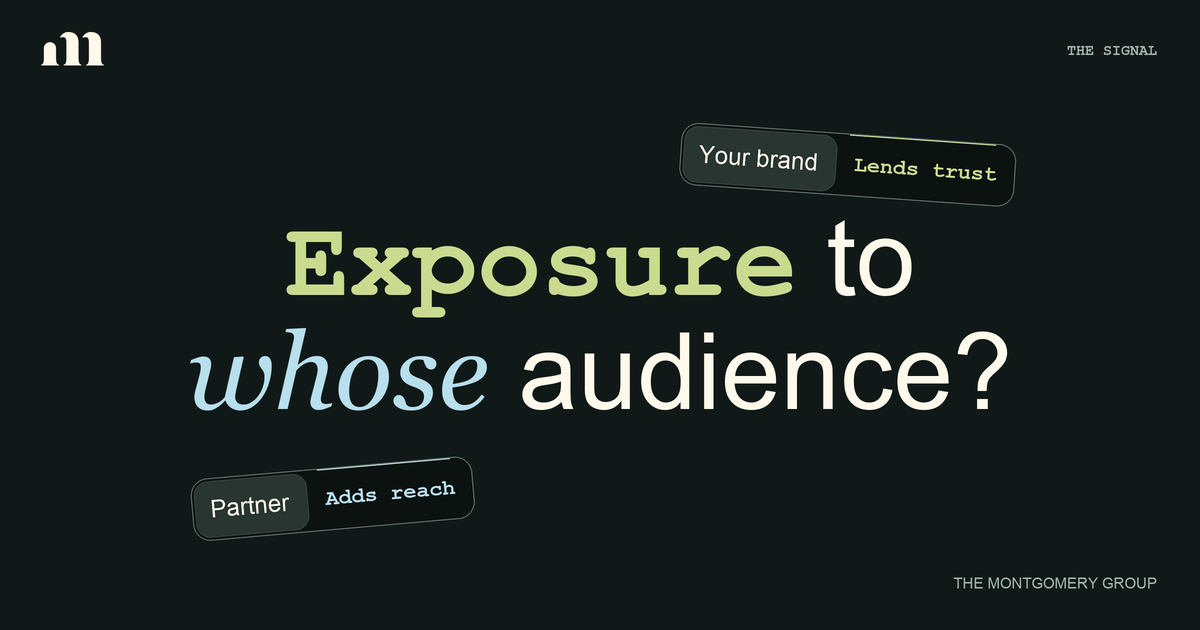
But my client caught something, and it was exactly the right thing to catch. The other side didn't just want a post. They wanted to use my client's name, their reputation, their audience. So if the audience is what makes the deal valuable... whose audience is it?
That one question flipped the whole conversation.
II. Exposure lets everybody skip the math
I like partnerships. I don't think every good exchange has to start with an invoice. Somebody can introduce you to people you'd never reach on your own. Two brands can make something together that neither one would have made alone.
But exposure is a slippery word. It can describe something real while skipping the part where anybody explains the trade. Everybody gets to sound generous and nobody has to get specific yet.
III. An audience isn't a logo file
If we're talking about an audience, we're talking about people who chose to pay attention to someone. That attention comes with context. They trust that person's judgment, or they like the work, or they just know what to expect when that name shows up.
A partner isn't really asking for a post. They're asking to step inside that trust. Sometimes they're asking to borrow it.
So the first thing I want on paper is what's actually leaving your side of the table. Finished creative? Permission to use someone's name and face in more places than this one post? An introduction to a group of people who already listen to you? Those aren't the same thing just because they all fit on a slide labeled "collaboration."
I'm not going to tell you there's a universal price for any of that. A big following doesn't guarantee a return. But not knowing the price doesn't make the contribution disappear.
IV. Visibility needs a direction
More visibility sounds great until you ask: visibility for what?
You can become more recognizable for something you don't actually want to be known for. A company can pull attention toward an offer it isn't ready to support. Nobody has to be dishonest for that to happen. The two sides just pictured the attention going different places.
Say a small business gets offered a feature in somebody else's campaign. It might reach a genuinely new audience. It could also be a bad trade if the small business is doing most of the production and the new audience has no real reason to care about what it does.
Or it might be a great deal. You have to read the actual offer to know.
That's also why I don't tell people to say no to every exposure pitch on principle. You can talk yourself out of really useful relationships by insisting every bit of value show up as cash. The point is to know what form the value is taking and what you're putting in to get it.
V. Settle the boring stuff before anyone hits record
How long does this run? Where does the content go? Who approves the version that goes live? What happens when the campaign changes?
A one-time appearance and an ongoing association can start with the exact same photo shoot. If nobody spells out the intended use, both sides can walk away thinking they agreed while picturing completely different things.
Those questions don't make a partnership less friendly. They're what keep it friendly once the work starts moving.
VI.
I hold TMG to the same standard. When we get excited about a partnership for a client, our excitement isn't an argument. We should be able to explain why the trade makes sense without leaning on how much "potential" it has.
Potential is easy to find in a proposal. The real work is figuring out who's carrying the risk and whether the upside actually reaches them.
Exposure's fine. Just finish the sentence.